
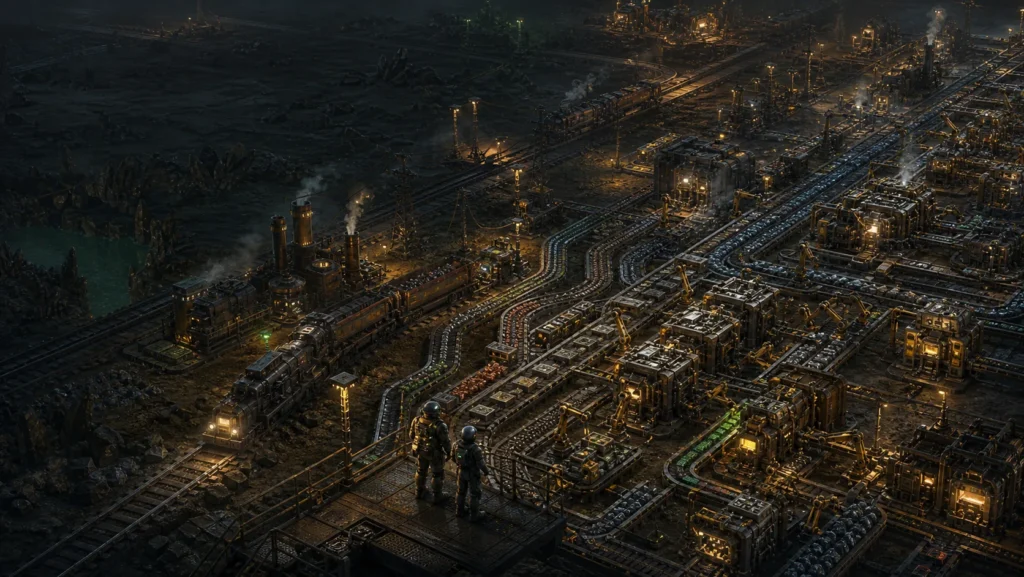
Factorio scales quickly in multiplayer. Two players can simultaneously build up power, melt, science and defense. Exactly this speed leads to chaos, however, if everyone redirects the same resources without consultation or replaces existing areas completely.
This guide shows a way of working for common saves. It is not a perfect blueprint or a ratio database. Version, DLCs and mods of the FLN project are on display Factorio-Serverseite.
Practice
Rounding instead of theory
The guide focuses on typical hurdles in real multiplayer.
Context
Global and FLN
General mechanics and server-specific instructions remain distinguishable.
Further information
Next step
Appropriate server, community and support channels are linked in the text.
Before take-off
First clarify the goal of the save. Do you just want to launch the rocket, fully play Space Age, build a megabase, or run a long-term community project? The goal influences how much planning makes sense in the beginning.
In addition, check:
- Game version and DLCs
- aktive Mods
- Card and opponent settings
- Access and server hours
- Dealing with breaks and AFK
- Backup and save responsibility
This information belongs on the server side. Don’t rely on an old mod profile or a locally stored server favorite.
The first 30 minutes
In the beginning, parallel work counts. One player organizes electricity and coal, another ore and smelting, a third the first automation and science steps. Defense and ammunition are not forgotten when opponents are active.
Do not immediately build every line permanently. A provisional construction may be ugly as long as it is clear when it will be replaced. Labelled boxes and short map tags help to ensure that intermediate storage is not interpreted as garbage.
A meaningful process:
- stabile Stromversorgung,
- automated iron and copper plates,
- Basic components such as Gears and Circuits,
- erste Science,
- ammunition and defence;
- Planning of the permanent production structure.
Distribute tasks without creating ownership claims
Areas of responsibility prevent duplication of work. One player takes care of electricity temporarily, another of oil, trains or science. This does not mean that this area becomes personal property. It just means that changes can be agreed there with a person who knows the construction.
Open tasks should be concrete. “More iron” is less helpful than “tethering second ore outpost and increasing plate input on the east side.” New players can thus make a clear contribution without having to understand the entire factory.
Uses card markings sparingly and identifies important areas uniformly. A station name like “Copper Ore 1” is better than five inside jokes that only the builder understands.
Main Bus and common standards
A main bus is an understandable introduction for many community saves, but not the only right solution. It bundles frequently needed materials on parallel belts and enables clearly recognizable branches.
Before the construction, you clarify:
- direction of the bus,
- space for additional lanes,
- which products are centrally managed,
- on which side production is diverted,
- and where to connect trains or bots later.
Reserve space without keeping half the card empty. The bus must fit to the Save destination. A factory for the first rocket launch does not need planning like a megabase.
Turns should not empty the main river unnoticed. Balancers and priorities are tools, but not mandatory decoration. Use it where there is an actual distribution problem.
Renovations and Blueprints
Small improvements do not need release. A large remodel needs a short message if it stops ongoing production, occupies areas of other areas or replaces a shared system.
A useful conversion announcement includes:
- aktuelles Problem,
- planned solution,
- betroffene Produktion,
- erwartete Unterbrechung,
- and the possibility of relapse in the event of errors.
External blueprints are checked before use. You can require other mods, modules, signal names or production goals. Large blueprints are tested first in a free area or on a separate save.
The Deconstruction Planner is especially dangerous when bots react immediately. Marks small sections, controls the selection and creates a save for critical areas beforehand.
Oil Processing
Oil is often the first point where an unplanned build-up is permanently in the way. Reserves space for crude oil supply, refineries, cracking, tanks and chemical production. Pipes should be guided in such a way that extensions remain possible and liquids are not mixed accidentally.
Clarifies which products have priority. Petroleum gas is often widely used; heavy and light oil can be further processed or used in a targeted manner. A clean tank and pump structure makes bottlenecks visible.
If you use circuits for control, document the conditions. A pump that remains closed due to an unknown signal is harder for other players to understand than a clearly labeled logic.
Trains and Signals
A railway network needs common rules. Sets direction of travel, track spacing, station names and train lengths before multiple players independently build routes. A uniform standard prevents each new outpost from creating a special case.
Normal signals divide the route into blocks. Chain signals are used in front of areas where a train should only enter when it can leave. The practical principle is that a train must not block an intersection just because its next block is occupied.
Test new hubs with multiple moves. A bodywork that works with a train may be stuck under load. Uses waiting areas when trains in front of a station should not block the main route.
Bots, performance and backups
Bots are ideal for construction, personal logistics and specific production areas. However, a huge common logistics network is not automatically better than belts or trains. Large flight paths and ever-changing requests can create unnecessary work.
Performance problems are measured and limited. Suspects include very large botnets, permanently active circuits, unnecessary entity quantities and poorly planned train traffic jams. Do not remove blanket systems that only look complex.
Backups protect joint progress. Before large remodelings or mod changes, a save is created. A rollback affects all players; it is therefore the last solution, not the personal undo after a wrong placement.
In Desync or Crash, you record the time, game version, mods and the last action. Underneath Technical problems Then there is the process.
Multiplayer-Etikette
Do not take resources without comment from a buffer that supplies critical production. Does not change stations and signals in the middle of the operation without checking the effect. Do not leave temporary constructions permanently unlabeled.
Mistakes happen. Report them directly instead of hiding them. An incorrect signal is corrected in two minutes; an hour later it may have become a complete production backlog.
Checkliste
- Target, version, DLCs and mods known
- Examined current open tasks
- Large conversions briefly announced
- externe Blueprints getestet
- Station name and train standard complied with
- Critical areas saved before changes
- Bottlenecks measured instead of guessed
- technical errors reported with time and context
For the current save and access you open the Factorio-Serverseite. Players for a sub-project can be found via Find players.
Frequent questions about Factorio multiplayer
Does an Factorio group need fixed roles?
No. More meaningful are visible areas of responsibility that can change if necessary: electricity, research, railway network, defence or a specific production chain. This way, everyone knows where help is needed, without rigid claims to ownership arising from cooperation.
Does Every Common Factory Need to Use a Main Bus?
A main bus is a helpful ordering principle, but not a mandatory model. Crucial are common standards for routes, reserves, transfer points and expansion areas. The FLN Factorio Server Describes how the common Save is organized.
What should I consider before a major renovation?
Speak off target, affected area and transition plan briefly. Secure critical production, mark temporary bottlenecks and use blueprints or a test area. In this way, the factory remains playable, while the new solution gradually takes over.
How do trains, bots and large factories remain performant?
Uniform signals, clear stations, limited logistics areas and comprehensible production goals help technically and organizationally. Before covering up symptoms with more bots, find the actual bottleneck and see if pathways or circuits create unnecessary work.
How do I get into an already advanced save?
First, get an overview and ask for open tasks. A delimited subproject is the best start, because you see effect without unintentionally changing central systems. Players and projects you will find about the Community.
Do everyone have to use the same Factorio version and the same mods?
Yes. Game version, mod list and mod versions must match, otherwise joining often already fails when synchronizing.
How do I protect the common score?
Plan regular backups, test large mod changes separately first, and don’t overwrite a working backup.
Where can I find players for a new factory?
Use the player search in the Discord or the group areas. Describe play style, mods and typical times so that suitable people react faster.
From “my machine” to “our factory”
The best multiplayer moment in Factorio rarely comes from the biggest blueprint. It is created when several sub-projects suddenly play together neatly: the station delivers on time, the melt keeps the beat, and an extension can be understood without ringing the builder out of bed. Labels, buffers and announced conversions are therefore not bureaucracy, but cooperative gameplay.
Then, look for an easy way to get started. Ask briefly, take over a subproject and document what you have changed. In this way, not only the factory grows, but also the trust in the team. Errors are allowed to be visible; hidden changes cost much more time in the end.
Find your place in the production chain
Check current Factorio save and server statusbefore you plan version, mods or larger construction projects.
For a common train line, mall or science production you can go to Find players Seek specific reinforcement.
Impressions
No comments yet
Comments add to the contribution. For support, reports or exile, please use the appropriate professional route.
Log in to comment
Comments run through your central customer account. Sign in or create an account by email or Discord; then you will come back to this post directly.