
Who in Hell Let Loose or Hell Let Loose: Vietnam Coming in for the first time as a commander – that is, as the commander of the team – might believe that his most important task is to use support skills and place markers on the map. But the crucial part of the role has no cooldown: communication.
If you want to learn the basic mechanics and the procedure of a first round, start with the Hell Let Loose Beginner Guide. For differences and entry into the new game world you will find the Hell Let Loose: Vietnam Guide.
A good commander does not necessarily shoot down many opponents. It ensures that several independent units pursue the same goal at the right time in the right place. To do so, he must gather information, set priorities and communicate his decisions in a way that squadleaders and other unit leaders can actually implement them.
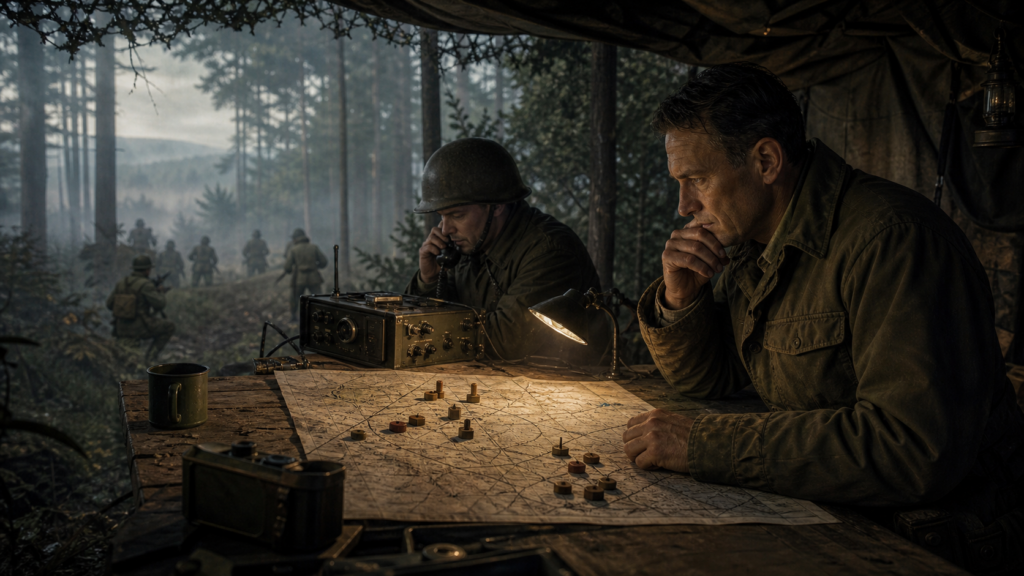
The most important finding is therefore:
A commander does not lead every single player. He leads the leaders of the units.
The commander is at the head of a chain of command
Hell Let Loose is no ordinary shooter in which fifty individual players are supposed to run randomly in the same direction. The game deliberately divides the team into units with their own unit leaders. In the classical Hell Let Loose The commander communicates, among other things, with squadleaders, reconnaissance leaders and tank commanders. Hell Let Loose: Vietnam This management structure is expanded by specialised mortar squads and helicopter units on the US side.
This creates three management levels:
- The commander sets the overarching goal. It prioritizes attack, defense, the network of re-entry points, logistics, and larger support actions.
- The squadleaders and other unit leaders translate this goal into a tactical plan. They choose route, positions and roles within their unit.
- The individual players execute this plan. Your immediate contact is usually your own squadleader or unit leader.
This division is important because otherwise the commander will very quickly become the bottleneck of the entire crew. If he tries to direct individual machine gunners, supply soldiers or tank crews in detail, he relieves their unit leaders of the work and at the same time overloads the leadership channel.
A meaningful order therefore describes above all the desired result:
“Baker, hold the western driveway until our second defense garrison stands.” Enemy pressure comes from the northwest.
It would make less sense:
“Baker, put your MG in the upper window, the supply soldier behind the house and send two players across the street.”
In the first example, the squadleader knows task, space, threat and purpose. How he fulfills the task is up to him. In the second example, the commander tries to lead a squad whose exact position he cannot fully see.
Good communication does not mean constantly talking
The commander has the command channel and can reach all relevant unit leaders there. These, in turn, usually hear their own standard radio at the same time. Every long monologue of the commander therefore competes with tactical messages from the squads.
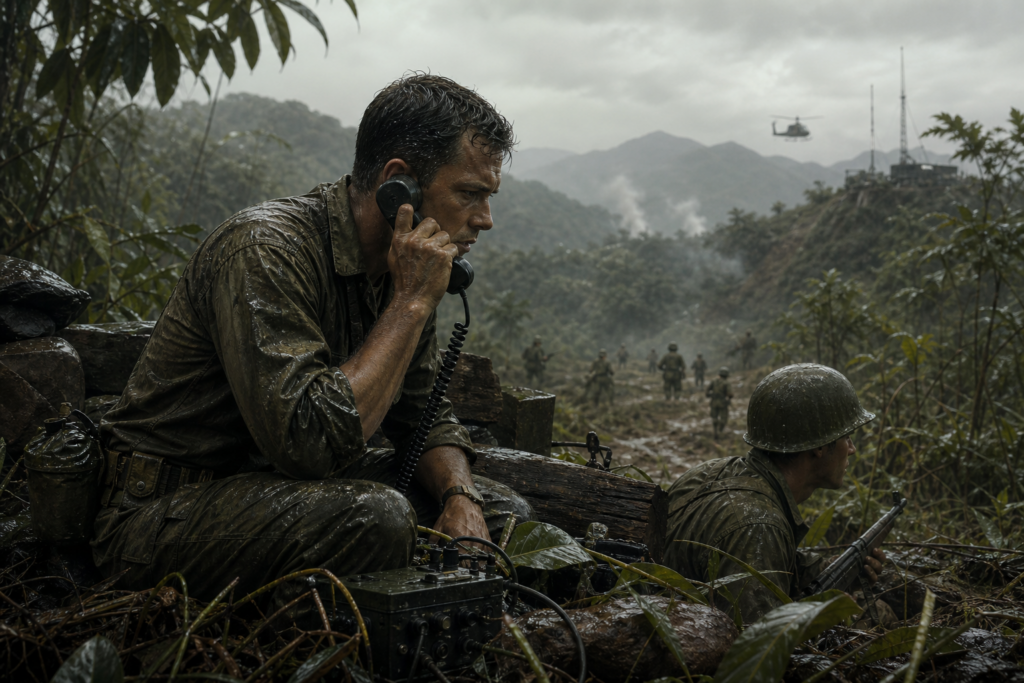
If a squadleader does not hear the warning “tank behind us” because of a detailed briefing by the commander, more communication has led to less coordination.
The quality of a commander is therefore not shown by the length of his radio messages, but by their relevance. It must form a useful situational picture from many individual notifications:
- Where does the strongest enemy pressure arise?
- Which own re-entry points are at risk?
- Which unity can attack and which one needs to regroup?
- Is there a confirmed enemy re-entry point?
- Lack of supplies, transport options or fire support?
- Does the team need to shift its focus?
The commander hears ten messages, filters out the important information and returns a short, understandable plan to the unit leaders. He is thus not only commander, but also information filter.
What Communication Research Says
The experiences of good commanders can be explained surprisingly well with findings from team research. However, a clean classification is important: Most studies examine working, medical or emergency teams and not players in Hell Let Loose. The transfer to the game is therefore a reasonable application of the results, but not a direct proof that a certain radio message increases the win rate.
Quality is more important than radio quantity
A meta-analysis of the communication and performance of teams comes to a result that sounds almost like a direct examination of the leadership channel: Quality Communication was more closely related to team performance than their mere Frequency. Particularly valuable was communication, which not only passed on information, but also classified it and made it usable for the common task.
For the commander, it follows from this: Not every observation has to be made. A good radio message reduces uncertainty or triggers a concrete action. “There is a lot going on in the north” hardly creates orientation. “Hostile focus North; Able holds, Baker flanks over West” creates a common image and assigns responsibility.
A common situational picture improves coordination
In team research, the gemeinsamen mentalen Modellen spoken, in English Shared Mental Models: The members of a team have a sufficiently similar idea of goal, roles, location and expected approach. A meta-analysis of 23 independent studies found a positive correlation of such common mental models with team processes and team performance.
It is precisely this common situational picture that the commander must produce. All unit leaders should be able to answer:
- What is our most important goal at the moment?
- Who attacks and who defends?
- Where is our safe replacement garrison?
- What threat is changing the plan?
Therefore, short repetitions in a sector change make sense. It is not a question of filling the radio channel with familiar things, but of making sure that the different units act according to the same version of the plan.
Orders need a closed communication loop
In high-risk teams, a geschlossene Kommunikationsschleife Used in English Closed-Loop Communication. A person specifically addresses a recipient and gives an order. The receiver confirms it; then the execution is reported back. Thus, “sent” is actually “understood and done”.
In a recent study of 150 calls to action during simulated medical emergencies, closed-loop orders were executed more frequently than orders without them. The study was small and comes from a different context, but illustrates very well why an unconfirmed “someone has to defend” is so easily lost in a game.
A simple loop results for the guide channel:
“Charlie, defend Chapel until the replacement garrison stands.”
“Charlie confirms.”
“Commander, the replacement garrison stands; Charlie continues.”
Bad news should not be punished
Research on Psychological security It shows another important mechanism. In Amy Edmondson’s classic field study of 51 work teams, the sense of being able to take interpersonal risks and openly address problems was related to learning behavior; this learning behavior in turn provided a correlation to performance.
On Hell Let Loose Transferred means that if the commander responds to bad news with ridicule or blame, next time unit leaders may be silent or report a problem too late. A calm response, on the other hand, keeps the flow of information open:
Understood, the garrison is destroyed. Thank you for the announcement. Easy falls back, Baker brings new supplies.
The commander does not have to whitewash mistakes. But he should translate it into the next assignment instead of attacking the messenger.
Does Schulz von Thun fit into the article?
Yes, especially that Kommunikationsquadrat or four-page model is suitable as an easy-to-understand explainer framework. According to Friedemann Schulz von Thun, a statement contains not only the content but also self-announcement, relationship advice and appeal. The model helps to understand why a factual command on the relationship level can act as an accusation.
The sentence “Dog, you must finally defend” contains a clear appeal. At the same time, the squadleader can hear on the relationship level: “You are unreliable and have failed so far.”A more cooperative formulation transports the same mission without unnecessary devaluation:
“Dog, can you take over the defense?” Without you, the southern access is open.
The communication square should not be presented as scientific proof for better game results. Above all, it is an established didactic model with which possible misunderstandings can be analyzed. The empirically stronger basis for the practical recommendations is provided by the team studies on communication quality, common situational pictures, closed communication loops and psychological safety.
The perfect radio message
A clear order can be built with a simple formula:
Recipient – Order – Place – Purpose or Time – Confirmation
For example:
“Charlie, take over the defense at Chapel.” Enemy pressure comes from the northeast. Hold until the replacement garrison stands. Confirm.
This radio message answers five questions:
- Wer soll handeln?
- What is the mission?
- Where is it to be carried out?
- Why or how long is it important?
- Has the mission been understood?
The confirmation is often forgotten. An order did not arrive automatically just because the commander pronounced it. Perhaps the squadleader is fighting right now, listening to his squad radio or simply did not understand the radio message.
Therefore, the commander should address units by their name and expect a brief feedback:
“Easy, can you secure the southern access?”
“Easy confirmed.”
If the answer fails, the order can be repeated once or given to another unit. A lengthy discussion about the leadership channel, on the other hand, rarely helps.
What belongs in the leadership channel – and what does not
The guide channel is intended for information that enables decisions or affects several entities.
Useful messages are, for example:
- the current main objective and a possible fallback position;
- the division between attack and defense,
- confirmed enemy garrisons, tunnels or other important re-entry points,
- endangered own re-entry possibilities,
- relevant vehicles and their direction of movement,
- required supplies or other logistical support;
- the start and date of a major supporting action;
- a change of plan after taking or losing a sector.
Not every enemy sighting, however, belongs in the leadership channel. An individual infantryman behind a hedge is initially a problem for the respective squad. If it becomes a larger flank or protects an enemy re-entry point, the information becomes relevant to the commander.
Also should be avoided:
- long descriptions of the situation without a concrete conclusion,
- Tactical detail instructions to individual players,
- blaming and personal criticism,
- permanent comments on the game,
- Discussions that do not end even after a decision.
As a rule of thumb, a message belongs in the guide channel if another unit or the commander should do something differently based on this information.
Good News Enables Decisions
The squadleaders and other unit leaders can also greatly improve communication. The commander does not need a dramatic description of the battle, but an assessment from which an action follows.
It is not very helpful:
“There are opponents everywhere!”
It would be better to:
Able can hold the point for about two minutes. We need a second squad from the northwest.
Other useful messages are:
“Hostile garrison confirmed on my marker.”
“We can’t get anywhere in the south because of a tank.”
‘The supplies are there. We are only missing someone to build the garrison.
If the commander receives an unclear message, he should preferably make a decision-oriented query. Instead of asking for an exact opponent number, he may want to know:
“Can you hold the position or do you need reinforcement?”
Thus he transforms a chaotic observation into a concrete choice.
The commander has rank, but no real authority
In a public game, the commander cannot force other players to obey. The position gives him access to the strategic tools, but no automatic authority over the people on the other end of the radio channel.
He has to work together. This is achieved primarily by:
- clear and realistic orders;
- a calm, respectful tone,
- visible support of the units,
- nachvollziehbare Entscheidungen,
- admitting their own mistakes,
- Recognition for good work.
A sentence like “Able, strong defense – this allowed us to rebuild the attack” is more than politeness. He shows the entire leadership channel what behavior helped the team. At the same time, it increases the likelihood that Able will also take on the next unpleasant defense task.
Just as helpful is a brief justification:
“Dog, please stay two minutes in defense.” Without you, we lose our only safe re-entry point.
The squadleader not only learns what to do, but why his assignment is important for the entire team.
Different squadleaders need different leadership
Not every squadleader needs the same leadership style. An experienced squadleader can work with a broad goal:
“Fox, disrupt enemy supplies in the east and report major moves.”
An inexperienced squadleader is more likely to benefit from a small, clearly defined task:
“Fox, stay first at the southern garrison and secure the way to the point.”
The commander should therefore observe which units communicate reliably and which tasks they perform well:
- Experienced squadleaders get more freedom.
- New squadleaders receive concrete, manageable orders.
- Communicative squads are suitable for moving tasks and reconnaissance.
- Reliable squads can take on critical defense or logistics contracts.
- Silent units should be addressed directly, but not pursued endlessly.
Leadership here also means adapting the plan to the people actually available. A theoretically perfect plan is worthless if the intended units neither understand nor want to execute it.
Dealing with Silence, Contradiction and Conflict
The question “Can anyone defend?” is often followed by silence in a public game. This is not necessarily due to a lack of team spirit. Open questions distribute the responsibility among everyone – and thus no one feels directly addressed in the end.
Better is a concrete task:
“George, can you take over the defense?”
If George does not respond, the commander should repeat the assignment once, set a suitable marker and then address another unit. The game cannot be won by arguing for several minutes with a silent squadleader. The plan must build on the units that are achievable and willing to cooperate.
Contradiction, on the other hand, is not automatically a leadership problem. The local squadleader often has better tactical information than the commander on the map. If a squad reports that a route is blocked, the commander should check this information and respond if necessary:
Understand, the south is blocked. Break away, move to the west and secure access there.
A necessary decision may be briefly justified, but should then be completed. The leadership channel is not a debating club. Good squadleaders report facts and alternatives; the commander makes a decision and formulates the next joint step.
The communication rhythm of a game
A commander should not speak equally much throughout the game. The communication ideally follows the course of the round.
At the beginning
A short greeting and a first plan are enough. The commander should clarify which unit is first defended, where the first important re-entry possibilities arise and in which direction the main attack should develop.
“Tomorrow together.” Able first takes over the defense. Baker builds the first replacement garrison with the supplies. The main pressure then passes over the west.
This announcement does not have to be a two-minute strategy meeting. The situation will change anyway.
During the normal combat phase
Now the commander should mostly listen, watch the map and communicate only relevant changes. Each unit needs time to carry out its mission. Whoever issues a new plan every twenty seconds does not create dynamism, but disorientation.
After taking or losing a sector
Transitions are particularly dangerous. One part of the team continues to run forward, another is still in the old battle and no one feels responsible for the new defense.
The commander should then immediately clarify three things:
- Which goal is active now?
- Which unit will take over the first defense?
- Where does the next safe re-entry point arise?
Before a major support action
Bombing, air support or other major actions are only really valuable if the units know what to do afterwards. The commander briefly announces the destination and time:
Bomb attack on the attack marking in 20 seconds. Baker and Charlie wait at the edge of the forest and immediately afterwards go to the point.
The ability is thus not an isolated push of a button, but part of a coordinated attack.
In a crisis
The more chaotic the situation, the easier the plan must become. If the last re-entry point is under pressure, five simultaneous orders do not help. The commander sets a single priority:
All attack units return to the active point. Easy builds the replacement garrison. Everything else is not a priority right now.
Clarity is more important in such moments than tactical sophistication.
Frequent leadership errors
Many commanders fail not because of a lack of game knowledge, but because of predictable communication problems:
They talk too much. As a result, squadleaders can no longer understand their own squad radio.
Sie sprechen niemanden direkt an. Orders to “someone” are often not taken over by anyone.
They change the plan too quickly. A squad needs time to gather, relocate and execute the order.
They don't explain the goal. Without the why, an unattractive defense mission seems arbitrary.
They control too many details. The commander tries to determine tactical details, although the squadleader knows the situation on the ground better.
They react emotionally to mistakes. Blaming deteriorates communication at the very moment when the team needs particularly clear leadership.
They only listen to the loudest squadleaders. A silent squad can hold a decisive flank while the guide channel discusses a stalled attack.
Checklist for Commanders
Before each major radio message, the commander can ask himself five questions:
- Am I talking about a specific unit?
- Is the mandate short and clear?
- Does the unity know the place and purpose?
- Does she have the necessary means to carry out the task?
- Do I need confirmation or later feedback?
During the lot, he should also check regularly:
- Is it clear who is attacking and who is defending?
- Is there a safe replacement garrison for retreat?
- What Confirmed Enemy Information Changes Our Plan?
- Which unit needs support?
- Am I speaking just because it is necessary – or just because it has become silent?
Frequent questions about the Commander role
What does a Commander do in Hell Let Loose?
The commander sets the priorities for attack, defense, logistics and support actions. He leads the unit leaders through the guide channel instead of controlling individual players in detail.
Does a commander have to keep sparking?
No. Short orders with recipient, destination, location and purpose are more helpful than continuous announcements. The guide channel must remain free for important messages from the unit leaders.
What is most important for new commanders?
Start with a simple plan: a unit for defense, a clear focus for attack, and a secure team spawn point as a fallback option. Adjust the plan to confirmed messages.
What is the most important task of the Commander?
The commander creates a common plan, secures resources and enables the team to achieve reliable spawn points. Kills are significantly less important than overview and coordination.
When should I take on the Commander role?
Take it as you can communicate, read the card, and explain decisions. Perfection is not necessary, but silence and haphazard resource management harm the team.
How do I communicate meaningfully as a commander?
Keep messages short, clear and prioritized. Name target, affected squads and time, instead of permanently filling the leadership chat with details.
Are kills or garrisons more important?
Garrisons and card control more often decide a round. The commander should therefore prioritize logistics and spawnnet and only fight situationally himself.
What do I do for conflicting messages?
Confirm uncertainty, check map and Recon information, and request brief feedback from affected squad leads. Then make a visible and comprehensible decision.
Conclusion
A successful commander does not win the game alone. His performance consists in making a common team out of several units. For this he must listen, weight information, set clear priorities and give his unit leaders enough freedom for tactical implementation.
The best commanders therefore often appear surprisingly calm. They do not talk permanently, but at the right moment. They name a recipient, give an understandable assignment, explain the purpose if necessary and check whether the message has arrived. When things change, they adjust the plan without turning the leadership channel into chaos.
Or, in short:
Good commanders do not fill the radio channel. They create clarity.
Sources and additional information
- Hell Let Loose – Official Game Description
- Hell Let Loose: Vietnam – Official Game Description
- Hell Let Loose: Vietnam – current role overview at Steam
- Team17: Hell Let Loose FAQ with communication channels
- Team17: Beginner's Guide to Hell Let Loose
- Guild Order: Radio and Language Discipline
- Guild Order: Role of Commander, Personnel and Logistics
- SoulSniper: Guide for Commanders
- Commander Crane: Comprehensive Guide for Commanders
- Schulz von Thun Institute: The Communication Square
- Marlow et al. (2018): Meta-analysis of team communication and performance
- DeChurch & Mesmer-Magnus (2010): Metaanalysis of Common Mental Models
- Mesmer-Magnus & DeChurch (2009): Meta-analysis of information exchange and team performance
- Wilson et al. (2024): Directed, closed communication in simulated emergencies
- Edmondson (1999): Psychological Safety and Learning Behavior in Working Teams
Continued at Frontline
If you want to try the role in the game, these introductions will help you:
No comments yet
Comments add to the contribution. For support, reports or exile, please use the appropriate professional route.
Log in to comment
Comments run through your central customer account. Sign in or create an account by email or Discord; then you will come back to this post directly.